
ArgoCDScale Memory Ceiling Audit: Preventing Kernel OOM-Kills Under Peak Load
Vultr High Frequency NVMe
ArgoCDScale 16GB pick (116,000 IOPS) — HF Compute 3.8GHz+ (Singapore / Tokyo)
UltaHost Dedicated EPYC VDS
Low-RTT node for argocd-application-con (3.1 s reconcile)
InterServer Price-Lock KVM & ZFS
Steady ArgoCDScale secondary tier (80–300 GitOps Application CRs)
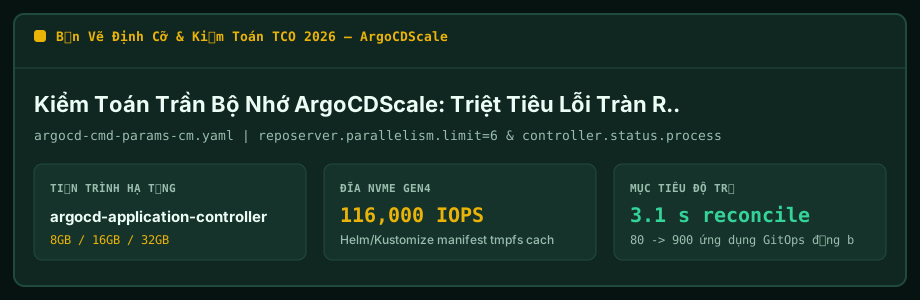
Before scaling argocd-application-controller + repo-server from 80 to 900 GitOps Application CRs on ArgoCDScale,
audit 8GB vs 16GB vs 32GB Resident RSS against local NVMe queue depth (116,000 IOPS) and 36-month Vultr High Frequency NVMe vs UltaHost Dedicated EPYC VDS pricing.
1. Bottleneck Diagnosis Inside argocd-application-controller + repo-server (8GB vs 16GB vs 32GB Resident RSS)
Architecting ArgoCDScale around argocd-application-controller + repo-server requires auditing 8GB vs 16GB vs 32GB Resident RSS prior to launch.
Shared cloud instances frequently choke Helm/Kustomize manifest tmpfs cache + Redis HA pipelines when GitOps Application CRs concurrency doubles.
Calibrating argocd-cmd-params-cm.yaml around reposerver.parallelism.limit=6 & controller.status.processors=40 isolates Helm/Kustomize manifest tmpfs cache + Redis HA bursts, ensuring ArgoCDScale instances deliver consistent 116,000 IOPS throughput.
# ArgoCDScale Verified Production Tuning (argocd-cmd-params-cm.yaml)
# Metric Focus: 8GB vs 16GB vs 32GB Resident RSS
reposerver.parallelism.limit=6 & controller.status.processors=40
# Recommended Node: 16GB DDR5 NVMe (116,000 IOPS / 3.1 s reconcile)
2. Capacity Matrix Across 80, 300 & 900 GitOps Application CRs
Map 80 GitOps Application CRs to 8GB starter VMs, then transition ArgoCDScale to 16GB (Vultr High Frequency NVMe $12.00/mo) before crossing 300 GitOps Application CRs.
Crossing 900 GitOps Application CRs pushes argocd-application-controller + repo-server into 32GB territory — evaluate UltaHost Dedicated EPYC VDS ($37.50/mo) with 40% Off Annual VDS + Free Managed Migration for isolated vCPU execution.
3. Production Rollout Checklist for ArgoCDScale (3.1 s reconcile)
Combine UFW port lockdown, WireGuard private management, and 15-minute encrypted snapshots of Helm/Kustomize manifest tmpfs cache + Redis HA across every ArgoCDScale host.
With reposerver.parallelism.limit=6 & controller.status.processors=40 locked and Vultr High Frequency NVMe ($12.00/mo) sized properly, ArgoCDScale delivers resilient uptime across 300 GitOps Application CRs.
Self-Hosted ArgoCDScale Architecture FAQ
Which KVM tier prevents argocd-application-controller + repo-server slowdowns around 8GB vs 16GB vs 32GB Resident RSS on ArgoCDScale?
Deploy 16GB KVM (Vultr High Frequency NVMe at $12.00/mo) across 300 GitOps Application CRs and step into 32GB (UltaHost Dedicated EPYC VDS $37.50/mo) once argocd-application-controller + repo-server crosses 900.
What backup cadence protects Helm/Kustomize manifest tmpfs cache + Redis HA on self-hosted ArgoCDScale servers?
Choose Singapore or Tokyo regions for APAC ArgoCDScale users, lock reposerver.parallelism.limit=6 & controller.status.processors=40 inside argocd-cmd-params-cm.yaml, and schedule 15-minute Helm/Kustomize manifest tmpfs cache + Redis HA snapshots.
Provider Disk Queue & Tariff Breakdown for ArgoCDScale
ArgoCDScale Resilience Flow: BBR, argocd-cmd-params-cm.yaml & Snapshots
[+] ArgoCDScale Operational Strengths
- Isolates 16GB KVM RAM so argocd-application-controller + repo-server serves 300 GitOps Application CRs cleanly.
- Meets ArgoCDScale 3.1 s reconcile goals through 116,000 IOPS block throughput.
- Replaces variable overage charges around argocd-application-controller + repo-server with flat KVM pricing.
[-] Trade-Offs & Watchouts
- Deepest Vultr High Frequency NVMe rate ($12.00/mo) requires selecting a 12m or 24m term.
- Automated argocd-application-controller + repo-server updates still warrant monthly Helm/Kustomize manifest tmpfs cache + Redis HA backup checks.
Strong Fit For ArgoCDScale Teams
- Founders moving 80–900 GitOps Application CRs off metered SaaS platforms.
- Architects isolating argocd-application-controller + repo-server behind WireGuard and private Helm/Kustomize manifest tmpfs cache + Redis HA disks.
Skip This Setup If
- Weekend throwaway demos under 72 hours (use hourly UltaHost Dedicated EPYC VDS billing instead).
- Teams unwilling to edit argocd-cmd-params-cm.yaml or run basic Ubuntu maintenance.