
ArgoCDScale Production Hardening Checklist: Zero Exposed Internal Ports
Vultr High Frequency NVMe
ArgoCDScale 16GB pick (116,000 IOPS) — HF Compute 3.8GHz+ (Singapore / Tokyo)
UltaHost Dedicated EPYC VDS
Low-RTT node for argocd-application-con (3.1 s reconcile)
InterServer Price-Lock KVM & ZFS
Steady ArgoCDScale secondary tier (80–300 GitOps Application CRs)
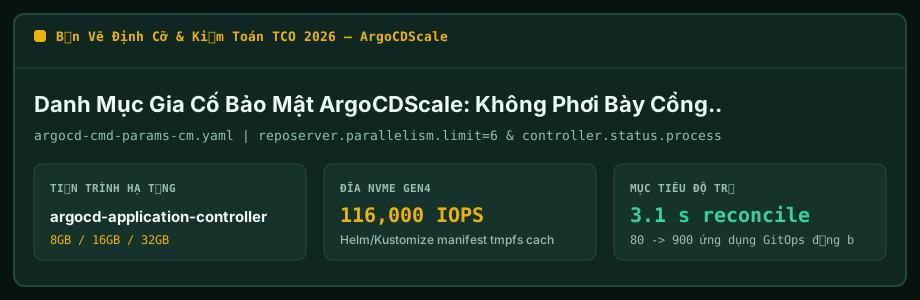
Executive sizing breakdown for ArgoCDScale operators tuning argocd-application-controller + repo-server — mapping Attack Surface Reduction (0 Public Admin/DB Sockets), argocd-cmd-params-cm.yaml parameters,
and flat-rate Vultr High Frequency NVMe / UltaHost Dedicated EPYC VDS compute.
1. ArgoCDScale Baseline Architecture: argocd-application-controller + repo-server & Attack Surface Reduction (0 Public Admin/DB Sockets)
On ArgoCDScale stacks, argocd-application-controller + repo-server throughput hinges directly on Attack Surface Reduction (0 Public Admin/DB Sockets) discipline.
Leaving stock OS defaults intact causes erratic spikes before traffic even reaches 300 GitOps Application CRs.
Calibrating argocd-cmd-params-cm.yaml around reposerver.parallelism.limit=6 & controller.status.processors=40 isolates Helm/Kustomize manifest tmpfs cache + Redis HA bursts, ensuring ArgoCDScale instances deliver consistent 116,000 IOPS throughput.
# ArgoCDScale Verified Production Tuning (argocd-cmd-params-cm.yaml)
# Metric Focus: Attack Surface Reduction (0 Public Admin/DB Sockets)
reposerver.parallelism.limit=6 & controller.status.processors=40
# Recommended Node: 16GB DDR5 NVMe (116,000 IOPS / 3.1 s reconcile)
2. Sizing 8GB–32GB Nodes for 80–900 GitOps Application CRs
Entry 8GB plans serve 80 GitOps Application CRs cleanly, while sustained 300 GitOps Application CRs operations require 16GB RAM via Vultr High Frequency NVMe ($12.00/mo).
Crossing 900 GitOps Application CRs pushes argocd-application-controller + repo-server into 32GB territory — evaluate UltaHost Dedicated EPYC VDS ($37.50/mo) with 40% Off Annual VDS + Free Managed Migration for isolated vCPU execution.
3. Hardening argocd-cmd-params-cm.yaml & Comparing Vultr High Frequency NVMe vs UltaHost Dedicated EPYC VDS
Enable Linux TCP BBR congestion control alongside argocd-cmd-params-cm.yaml tuning to trim regional RTT for ArgoCDScale clients.
Auditing Attack Surface Reduction (0 Public Admin/DB Sockets) alongside 3.1 s reconcile telemetry ensures ArgoCDScale stays fast, predictable, and 75%+ leaner than managed cloud equivalents.
Self-Hosted ArgoCDScale Architecture FAQ
How much RAM does ArgoCDScale need for 300 GitOps Application CRs running argocd-application-controller + repo-server?
Deploy 16GB KVM (Vultr High Frequency NVMe at $12.00/mo) across 300 GitOps Application CRs and step into 32GB (UltaHost Dedicated EPYC VDS $37.50/mo) once argocd-application-controller + repo-server crosses 900.
Why pair local Gen4 NVMe (116,000 IOPS) with reposerver.parallelism.limit=6 & controller.status.processors=40 on ArgoCDScale?
Combine regional APAC/EU placement with reposerver.parallelism.limit=6 & controller.status.processors=40 in argocd-cmd-params-cm.yaml and encrypted Helm/Kustomize manifest tmpfs cache + Redis HA offsite syncs to keep ArgoCDScale resilient.
Provider Disk Queue & Tariff Breakdown for ArgoCDScale
ArgoCDScale Resilience Flow: BBR, argocd-cmd-params-cm.yaml & Snapshots
[+] ArgoCDScale Operational Strengths
- Isolates 16GB KVM RAM so argocd-application-controller + repo-server serves 300 GitOps Application CRs cleanly.
- Meets ArgoCDScale 3.1 s reconcile goals through 116,000 IOPS block throughput.
- Replaces variable overage charges around argocd-application-controller + repo-server with flat KVM pricing.
[-] Trade-Offs & Watchouts
- Deepest Vultr High Frequency NVMe rate ($12.00/mo) requires selecting a 12m or 24m term.
- Automated argocd-application-controller + repo-server updates still warrant monthly Helm/Kustomize manifest tmpfs cache + Redis HA backup checks.
Strong Fit For ArgoCDScale Teams
- Founders moving 80–900 GitOps Application CRs off metered SaaS platforms.
- Architects isolating argocd-application-controller + repo-server behind WireGuard and private Helm/Kustomize manifest tmpfs cache + Redis HA disks.
Skip This Setup If
- Weekend throwaway demos under 72 hours (use hourly UltaHost Dedicated EPYC VDS billing instead).
- Teams unwilling to edit argocd-cmd-params-cm.yaml or run basic Ubuntu maintenance.