
ArgoCDScale Storage I/O Guide: Sustaining 116,000 IOPS Without Disk Steal
Vultr High Frequency NVMe
ArgoCDScale 16GB pick (116,000 IOPS) — HF Compute 3.8GHz+ (Singapore / Tokyo)
UltaHost Dedicated EPYC VDS
Low-RTT node for argocd-application-con (3.1 s reconcile)
InterServer Price-Lock KVM & ZFS
Steady ArgoCDScale secondary tier (80–300 GitOps Application CRs)
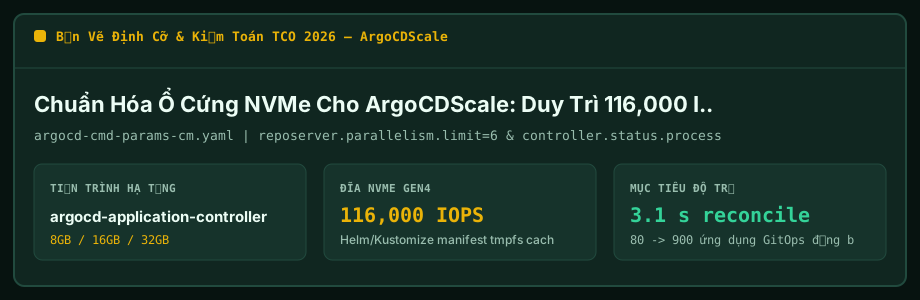
Verified 2026-11-12 ArgoCDScale specification for argocd-application-controller + repo-server, detailing 4K Random Write (116,000 IOPS Target), Helm/Kustomize manifest tmpfs cache + Redis HA I/O ceilings,
and Vultr High Frequency NVMe ($12.00/mo) vs UltaHost Dedicated EPYC VDS ($37.50/mo).
1. ArgoCDScale Baseline Architecture: argocd-application-controller + repo-server & 4K Random Write (116,000 IOPS Target)
Inside ArgoCDScale environments, 4K Random Write (116,000 IOPS Target) dictates whether argocd-application-controller + repo-server holds 3.1 s reconcile or drops connections.
Undersized nodes fail rapidly under Helm/Kustomize manifest tmpfs cache + Redis HA contention.
Pinning reposerver.parallelism.limit=6 & controller.status.processors=40 inside argocd-cmd-params-cm.yaml bounds worst-case allocation cleanly. Pair that rule with 116,000 IOPS NVMe storage to keep ArgoCDScale response times near 3.1 s reconcile.
# ArgoCDScale Verified Production Tuning (argocd-cmd-params-cm.yaml)
# Metric Focus: 4K Random Write (116,000 IOPS Target)
reposerver.parallelism.limit=6 & controller.status.processors=40
# Recommended Node: 16GB DDR5 NVMe (116,000 IOPS / 3.1 s reconcile)
2. Sizing 8GB–32GB Nodes for 80–900 GitOps Application CRs
Sub-80 GitOps Application CRs deployments operate inside 8GB, but 300 GitOps Application CRs production stacks need 16GB on Vultr High Frequency NVMe ($12.00/mo).
When ArgoCDScale expands to 900 GitOps Application CRs, provisioning 32GB RAM on UltaHost Dedicated EPYC VDS ($37.50/mo) locks in 3.1 s reconcile consistency.
3. Hardening argocd-cmd-params-cm.yaml & Comparing Vultr High Frequency NVMe vs UltaHost Dedicated EPYC VDS
Enable Linux TCP BBR congestion control alongside argocd-cmd-params-cm.yaml tuning to trim regional RTT for ArgoCDScale clients.
Auditing 4K Random Write (116,000 IOPS Target) alongside 3.1 s reconcile telemetry ensures ArgoCDScale stays fast, predictable, and 75%+ leaner than managed cloud equivalents.
Common argocd-application-controller + repo-server Deployment Questions
How much RAM does ArgoCDScale need for 300 GitOps Application CRs running argocd-application-controller + repo-server?
Target 16GB KVM instances ($12.00/mo on Vultr High Frequency NVMe) once argocd-application-controller + repo-server reaches 300 GitOps Application CRs, and scale to 32GB (UltaHost Dedicated EPYC VDS) at 900 GitOps Application CRs.
Why pair local Gen4 NVMe (116,000 IOPS) with reposerver.parallelism.limit=6 & controller.status.processors=40 on ArgoCDScale?
Combine regional APAC/EU placement with reposerver.parallelism.limit=6 & controller.status.processors=40 in argocd-cmd-params-cm.yaml and encrypted Helm/Kustomize manifest tmpfs cache + Redis HA offsite syncs to keep ArgoCDScale resilient.
Provider Disk Queue & Tariff Breakdown for ArgoCDScale
ArgoCDScale Resilience Flow: BBR, argocd-cmd-params-cm.yaml & Snapshots
[+] ArgoCDScale Operational Strengths
- Isolates 16GB KVM RAM so argocd-application-controller + repo-server serves 300 GitOps Application CRs cleanly.
- Meets ArgoCDScale 3.1 s reconcile goals through 116,000 IOPS block throughput.
- Replaces variable overage charges around argocd-application-controller + repo-server with flat KVM pricing.
[-] Trade-Offs & Watchouts
- Deepest Vultr High Frequency NVMe rate ($12.00/mo) requires selecting a 12m or 24m term.
- Automated argocd-application-controller + repo-server updates still warrant monthly Helm/Kustomize manifest tmpfs cache + Redis HA backup checks.
Strong Fit For ArgoCDScale Teams
- Founders moving 80–900 GitOps Application CRs off metered SaaS platforms.
- Architects isolating argocd-application-controller + repo-server behind WireGuard and private Helm/Kustomize manifest tmpfs cache + Redis HA disks.
Skip This Setup If
- Weekend throwaway demos under 72 hours (use hourly UltaHost Dedicated EPYC VDS billing instead).
- Teams unwilling to edit argocd-cmd-params-cm.yaml or run basic Ubuntu maintenance.