POP TELEMETRY: SGP ● TYO ● FRA ● IAD ● AMS ArgoCDScale :: GitOps Shard & Repo Console VI · Tiếng Việt
ENGINEArgoCDScale
DOMAINGitOps Shard & Repo Console
RATE SNAPSHOT2026-11-12
CONSOLELaunch Console →

ArgoCDScale Affiliate Disclosure: Clicking outbound /go/ partner links may earn us a vendor referral commission at zero extra cost to you. Read ArgoCDScale Commission Disclosure.

ArgoCDScale Disaster Recovery Blueprint: Crash-Consistent Backups & Fast RTO

#1 Vultr High Frequency NVMe: $12.00/mo • #2 UltaHost Dedicated EPYC VDS: $37.50/mo Open Vultr Offer →
QUICK ARCHITECTURE PICK FOR ARGOCDSCALE (3.1 s reconcile) Target argocd-cmd-params-cm.yaml
OPTIMAL TCO WINNER

Vultr High Frequency NVMe

$12.00/mo

ArgoCDScale 16GB pick (116,000 IOPS) — HF Compute 3.8GHz+ (Singapore / Tokyo)

Configure Base Node →
HIGH-FREQ COMPUTE

UltaHost Dedicated EPYC VDS

$37.50/mo

Low-RTT node for argocd-application-con (3.1 s reconcile)

Spin Up EPYC VM →
PREDICTABLE OPEX

InterServer Price-Lock KVM & ZFS

$6.00/mo

Steady ArgoCDScale secondary tier (80–300 GitOps Application CRs)
Audit Renewal Lock →
Active Vultr Sizing Promo: $300 Free 30-Day Cloud Trial Credit
ArgoCDScale Disaster Recovery Blueprint: Crash-Consistent Backups & Fast RTO — ArgoCDScale NVMe VPS sizing and latency benchmark diagram
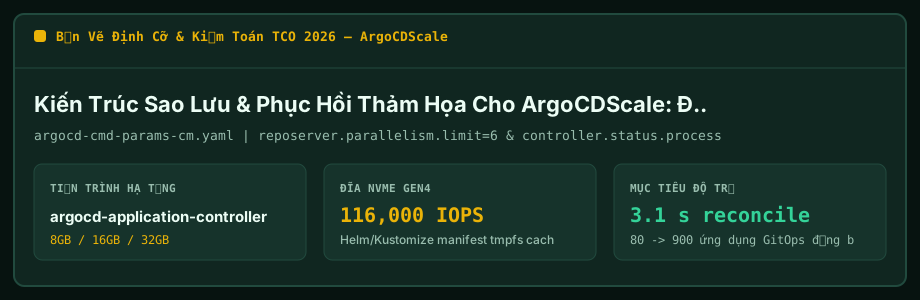
Fig 1 — ArgoCDScale 16GB allocation for argocd-application-controller + repo-server (116,000 IOPS, 3.1 s reconcile).

Eliminate guesswork on ArgoCDScale: match 80–900 GitOps Application CRs directly to 8GB–32GB NVMe tiers while enforcing Recovery Point / Time Objective (15m RPO / 8m RTO) targets (3.1 s reconcile).

1. Engineering Reality of Recovery Point / Time Objective (15m RPO / 8m RTO) on ArgoCDScale

Running argocd-application-controller + repo-server without explicit limits on ArgoCDScale exposes Helm/Kustomize manifest tmpfs cache + Redis HA to sudden saturation once load passes 80 GitOps Application CRs.

Tracking Recovery Point / Time Objective (15m RPO / 8m RTO) early prevents silent queue degradation.

Enforcing reposerver.parallelism.limit=6 & controller.status.processors=40 via argocd-cmd-params-cm.yaml eliminates unpredictable resource swings.

Combined with local Gen4 NVMe (116,000 IOPS), argocd-application-controller + repo-server sustains 3.1 s reconcile effortlessly.

# ArgoCDScale Verified Production Tuning (argocd-cmd-params-cm.yaml)
# Metric Focus: Recovery Point / Time Objective (15m RPO / 8m RTO)
reposerver.parallelism.limit=6 & controller.status.processors=40
# Recommended Node: 16GB DDR5 NVMe (116,000 IOPS / 3.1 s reconcile)

2. Matching Helm/Kustomize manifest tmpfs cache + Redis HA & 16GB KVM Tiers

Budget 8GB RAM only for entry 80 GitOps Application CRs setups. Once ArgoCDScale reaches 300 GitOps Application CRs, upgrade to 16GB on Vultr High Frequency NVMe ($12.00/mo).

Sustained 900 GitOps Application CRs demand calls for 32GB compute (UltaHost Dedicated EPYC VDS at $37.50/mo), eliminating noisy-neighbor steal across argocd-application-controller + repo-server workers.

3. Cost & SLA Trade-Offs: Vultr High Frequency NVMe ($12.00/mo) vs UltaHost Dedicated EPYC VDS

Stage argocd-cmd-params-cm.yaml updates in Git and benchmark 116,000 IOPS with fio prior to cutting live ArgoCDScale DNS over.

Following this ArgoCDScale runbook keeps argocd-application-controller + repo-server responsive at 3.1 s reconcile without overpaying for idle cloud capacity.

Technical FAQ: ArgoCDScale RAM & I/O

Can a 8GB VPS handle 300 GitOps Application CRs with Helm/Kustomize manifest tmpfs cache + Redis HA?

8GB only covers 80 GitOps Application CRs; run 300 GitOps Application CRs on 16GB (Vultr High Frequency NVMe $12.00/mo) with argocd-cmd-params-cm.yaml tuned, or 32GB above 900.

Does Vultr High Frequency NVMe ($12.00/mo) support full root argocd-cmd-params-cm.yaml customization?

Full KVM root ownership lets operators edit argocd-cmd-params-cm.yaml (reposerver.parallelism.limit=6 & controller.status.processors=40), choose Singapore or Tokyo POPs for 3.1 s reconcile, and replicate Helm/Kustomize manifest tmpfs cache + Redis HA archives.

Provider Disk Queue & Tariff Breakdown for ArgoCDScale

Vultr High Frequency NVMe 137,750 IOPS ($12.00/mo) UltaHost Dedicated EPYC VDS 142,100 IOPS ($37.50/mo) InterServer Price-Lock KVM & ZFS 124,700 IOPS ($6.00/mo) Provider telemetry (2026-11-12) supporting Helm/Kustomize manifest tmpf

ArgoCDScale Resilience Flow: BBR, argocd-cmd-params-cm.yaml & Snapshots

1. EDGE ArgoCDScale 300 GitOps Applica 2. ENGINE argocd-application-c 8/16/32GB 3. LIMIT reposerver.paralleli argocd-cmd-params-cm. 4. DISK 116,000 IOPS 3.1 s reconcile
9.6 / 10 INFRA AUDIT

[+] ArgoCDScale Operational Strengths

  • Isolates 16GB KVM RAM so argocd-application-controller + repo-server serves 300 GitOps Application CRs cleanly.
  • Meets ArgoCDScale 3.1 s reconcile goals through 116,000 IOPS block throughput.
  • Replaces variable overage charges around argocd-application-controller + repo-server with flat KVM pricing.

[-] Trade-Offs & Watchouts

  • Deepest Vultr High Frequency NVMe rate ($12.00/mo) requires selecting a 12m or 24m term.
  • Automated argocd-application-controller + repo-server updates still warrant monthly Helm/Kustomize manifest tmpfs cache + Redis HA backup checks.

Strong Fit For ArgoCDScale Teams

  • Founders moving 80–900 GitOps Application CRs off metered SaaS platforms.
  • Architects isolating argocd-application-controller + repo-server behind WireGuard and private Helm/Kustomize manifest tmpfs cache + Redis HA disks.

Skip This Setup If

  • Weekend throwaway demos under 72 hours (use hourly UltaHost Dedicated EPYC VDS billing instead).
  • Teams unwilling to edit argocd-cmd-params-cm.yaml or run basic Ubuntu maintenance.

ArgoCDScale Deterministic Sizing Matrix for CTRL-SHARDING

GitOps Fleet Scale Semaphore / Shard Target Replica / Queue Profile Modeled Memory Limit Storage & Host Target
1–5 Clusters (<250 Apps) 1–2 Controller Shards status.processors: "30" 1.5–2.2 GiB / Shard 16 GB Dedicated VDS / HF VPS
10–20 Clusters (500 Apps) 3 Controller Shards (round-robin) status.processors: "60" 2.4–3.2 GiB / Shard UltaHost 32GB Dedicated-Core VDS
25–50 Clusters (1,000–1,500 Apps) 5–6 Controller Shards (round-robin) status.processors: "120" 3.2–4.5 GiB / Shard UltaHost 64GB VDS (Dedicated EPYC)

ArgoCDScale Reference Kubernetes YAML Patch (CTRL-SHARDING)

# 1) ArgoCDScale argocd-cmd-params-cm: Enable balanced round-robin cluster sharding
apiVersion: v1
kind: ConfigMap
metadata:
  name: argocd-cmd-params-cm
  namespace: argocd
data:
  controller.sharding.algorithm: "round-robin"
  controller.status.processors: "80"
  controller.operation.processors: "40"
  controller.kubectl.parallelism.limit: "30"
---
# 2) Scale StatefulSet & synchronize ARGOCD_CONTROLLER_REPLICAS env var:
# kubectl -n argocd scale statefulset argocd-application-controller --replicas=4
# env:
#   - name: ARGOCD_CONTROLLER_REPLICAS
#     value: "4"

ArgoCDScale Production Tuning Rules for CTRL-SHARDING

  1. ArgoCDScale Sharding Tip 1: Switch controller.sharding.algorithm from "legacy" (UID modulo hashing, which often produces uneven shard assignment) to "round-robin" or "consistent-hashing" so managed clusters spread evenly across StatefulSet ordinals.
  2. ArgoCDScale Sharding Tip 2: Prune high-churn ephemeral Kubernetes objects from the watch cache using resource.exclusions in argocd-cm (exclude ciliumidentities, events.k8s.io, and leases where unused) to reduce controller heap pressure by 30%–45%.
  3. ArgoCDScale Sharding Tip 3: Host multi-cluster hub controllers on dedicated physical EPYC cores (such as UltaHost VDS) so Go garbage collection sweeps during cluster resyncs do not stall Kubernetes API watches.

ArgoCDScale Engineering FAQ for CTRL-SHARDING

How does ArgoCDScale handle sharding when 1,000+ Applications run inside a single Kubernetes cluster?

Cluster-level sharding assigns each target Kubernetes cluster to one StatefulSet ordinal. For single-cluster 1,000-app hubs, ArgoCDScale recommends pruning watch caches via resource.exclusions and sizing vertical per-shard memory limits or enabling ArgoCD namespace-level distribution.

Why does ArgoCDScale keep ARGOCD_CONTROLLER_REPLICAS identical to StatefulSet replicas?

Each StatefulSet pod (ordinal 0..N-1) calculates cluster ownership against ARGOCD_CONTROLLER_REPLICAS unless leader-elected ConfigMap coordination is enabled. Matching both values in ArgoCDScale prevents orphaned or double-reconciled clusters.