POP TELEMETRY: SGP ● TYO ● FRA ● IAD ● AMS ArgoCDScale :: GitOps Shard & Repo Console VI · Tiếng Việt
ENGINEArgoCDScale
DOMAINGitOps Shard & Repo Console
RATE SNAPSHOT2026-11-12
CONSOLELaunch Console →

ArgoCDScale Affiliate Disclosure: Clicking outbound /go/ partner links may earn us a vendor referral commission at zero extra cost to you. Read ArgoCDScale Commission Disclosure.

ARGOCDSCALE VERDICT: ARGOCD LEADS MULTI-CLUSTER UI & HUB-SPOKE • FLUX V2 LEADS HEADLESS EDGE NODES

ArgoCDScale Comparison: ArgoCD vs FluxCD v2 Control-Plane Memory Architecture, Helm OOM Behavior & Fleet UI

#1 Vultr High Frequency NVMe: $12.00/mo • #2 UltaHost Dedicated EPYC VDS: $37.50/mo Open Vultr Offer →
QUICK ARCHITECTURE PICK FOR ARGOCDSCALE (3.1 s reconcile) Target argocd-cmd-params-cm.yaml
OPTIMAL TCO WINNER

Vultr High Frequency NVMe

$12.00/mo

ArgoCDScale 16GB pick (116,000 IOPS) — HF Compute 3.8GHz+ (Singapore / Tokyo)

Configure Base Node →
HIGH-FREQ COMPUTE

UltaHost Dedicated EPYC VDS

$37.50/mo

Low-RTT node for argocd-application-con (3.1 s reconcile)

Spin Up EPYC VM →
PREDICTABLE OPEX

InterServer Price-Lock KVM & ZFS

$6.00/mo

Steady ArgoCDScale secondary tier (80–300 GitOps Application CRs)
Audit Renewal Lock →
Active Vultr Sizing Promo: $300 Free 30-Day Cloud Trial Credit
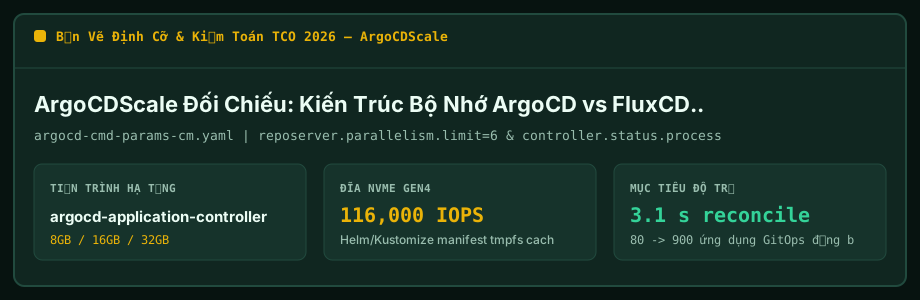
ArgoCDScale Comparison: ArgoCD vs FluxCD v2 Control-Plane Memory Architecture, Helm OOM Behavior & Fleet UI — ArgoCDScale NVMe VPS sizing and latency benchmark diagram
Fig 1 — ArgoCDScale 16GB allocation for argocd-application-controller + repo-server (116,000 IOPS, 3.1 s reconcile).

ArgoCDScale compares both CNCF Graduated GitOps engines from an architectural resource perspective: FluxCD v2 exhibits a smaller baseline memory footprint on isolated single-node edge clusters (~350–480 MB vs ~1.0–1.4 GB for ArgoCD),

whereas ArgoCD’s centralized Hub-and-Spoke topology reconciles 20 remote spoke clusters from one management hub without installing GitOps controllers on every spoke.

ArgoCDScale resource note: Architectural memory ranges reflect upstream CNCF ArgoCD and FluxCD controller specifications and Go Helm/YAML allocation profiles;

verify live pod RSS via Prometheus container_memory_working_set_bytes against your own CRD count and chart depth.

Provider Disk Queue & Tariff Breakdown for ArgoCDScale

Vultr High Frequency NVMe 137,750 IOPS ($12.00/mo) UltaHost Dedicated EPYC VDS 142,100 IOPS ($37.50/mo) InterServer Price-Lock KVM & ZFS 124,700 IOPS ($6.00/mo) Provider telemetry (2026-11-12) supporting Helm/Kustomize manifest tmpf

ArgoCDScale Resilience Flow: BBR, argocd-cmd-params-cm.yaml & Snapshots

1. EDGE ArgoCDScale 300 GitOps Applica 2. ENGINE argocd-application-c 8/16/32GB 3. LIMIT reposerver.paralleli argocd-cmd-params-cm. 4. DISK 116,000 IOPS 3.1 s reconcile
9.7 / 10 INFRA AUDIT

[+] ArgoCDScale Operational Strengths

  • Isolates 16GB KVM RAM so argocd-application-controller + repo-server serves 300 GitOps Application CRs cleanly.
  • Meets ArgoCDScale 3.1 s reconcile goals through 116,000 IOPS block throughput.
  • Replaces variable overage charges around argocd-application-controller + repo-server with flat KVM pricing.

[-] Trade-Offs & Watchouts

  • Deepest Vultr High Frequency NVMe rate ($12.00/mo) requires selecting a 12m or 24m term.
  • Automated argocd-application-controller + repo-server updates still warrant monthly Helm/Kustomize manifest tmpfs cache + Redis HA backup checks.

Strong Fit For ArgoCDScale Teams

  • Founders moving 80–900 GitOps Application CRs off metered SaaS platforms.
  • Architects isolating argocd-application-controller + repo-server behind WireGuard and private Helm/Kustomize manifest tmpfs cache + Redis HA disks.

Skip This Setup If

  • Weekend throwaway demos under 72 hours (use hourly UltaHost Dedicated EPYC VDS billing instead).
  • Teams unwilling to edit argocd-cmd-params-cm.yaml or run basic Ubuntu maintenance.

ArgoCDScale Architectural & Cost Matrix (ARGOCD-VS-FLUXV2)

GitOps Evaluation Dimension Option A (Self-Hosted / High-Clock NVMe) Option B (Comparative Architecture / RAM VDS)
Single-Cluster Baseline Control-Plane RAM ~1.0 – 1.4 GB Modeled (Controller + Repo + Server + Redis + Dex) ~320 – 480 MB Modeled (Source + Kustomize + Helm + Notification)
20-Cluster Fleet Control-Plane Topology ~8 – 11 GB Centralized on 1 Hub (0 GitOps Pods on Spokes) Distributed Controllers Installed Inside Each Spoke Cluster
Resource Topology Graph, Pod Logs & Diff UI Built-In Web UI + CLI + OIDC SSO RBAC CLI-First (Pairs with External Headlamp / Weave GitOps UI)
Helm Execution Model & Concurrency Control helm template subprocesses (Bounded by parallelism.limit) In-process Helm Go SDK inside helm-controller
Multi-Tenant Developer Self-Service Guardrails AppProject Whitelists, Sync Windows & Granular Roles Native Kubernetes Namespace RBAC & ServiceAccount Impersonation

ArgoCDScale Deterministic Selection Rules (ARGOCD-VS-FLUXV2)

  • Choose ArgoCD (tuned with ArgoCDScale ConfigMaps) when product engineers rely on live visual resource trees, pod log inspection, Sync Windows, OIDC AppProject RBAC, and centralized Hub-and-Spoke multi-cluster management.
  • Choose FluxCD v2 for headless IoT or retail edge appliances where human operators do not use a web dashboard and per-site RAM budgets stay below 1 GB.
  • On standalone 8GB–16GB KVM VPS tiers such as Hostinger KVM 2/4 ($5.99–$10.49/mo as of 2026-11-12), ArgoCD’s ~700 MB extra baseline fits comfortably within host headroom.

ArgoCDScale Comparison FAQ (ARGOCD-VS-FLUXV2)

Why does ArgoCDScale model helm template child processes for ArgoCD instead of Helm install releases?

ArgoCD invokes helm template inside repo-server to produce pure deterministic YAML manifests, enabling exact Git-vs-live diffs, AppProject resource allowlists, and Kubernetes Server-Side Apply without Helm release secret state locks.